1 - Symbolism in Politics
A hallmark of the left is a diversity of principles which are as often virtuous as they are ill-formed and contradictory self-defeating. It is an obvious and inevitable feature of simultaneously supporting an infinite number of marginalized groups. The left is credited with representing many in need, but in attempting to represent every group it fails as a system to represent anyone properly. Inclusiveness becomes an ironic form of exclusivity. While expert at "revolutions," it is poor at maintaining the stable space required to benefit those it attends to. These revolutions tend to occur at the most illiberal point in its life cycle and pave the way for dictators that will take advantage of the resulting destabilization. In the most extreme cases, we can see the breakdown of the left by comparing its intentions (eutopia, "liberty, equality, fraternity") with the result (mass poverty, authoritarianism).
The hallmark of the right is the establishment and maintenance of stable space with a narrow set of principles. Artificially established space comes about through order, i.e. hierarchies, laws, and force. These obviously and inevitably produce marginalized groups at the mercy of the ruling class. However, the marginalized also benefit from the stability of the space by degrees. The tendency toward authoritarianism is a feature of the right, as is slowness to adapt, and failure to consider new and potentially better ideas which the left sometimes provides. In its most extreme cases, the right intentionally produces a dictatorial empire that demands conformity (order). Through expansion inevitably spreads itself too thin. The comfort of stable space produces weakness[1], and it collapses on itself (returns to chaos).
*Rule of law vs anarchy is not a true right/left dichotomy. As mentioned, the extreme rule of law results in essentially the same situation on either side and the differences are too subtle to practically matter. The extreme lack of government is a vacuum and therefore can never last. Power is what allows either side to enact its dictates. Both are balanced by a lack of power. This is the understanding of classical liberals, centrists, Libertarians, and is the reason for the republic and separate branches of the government.
A post on X:
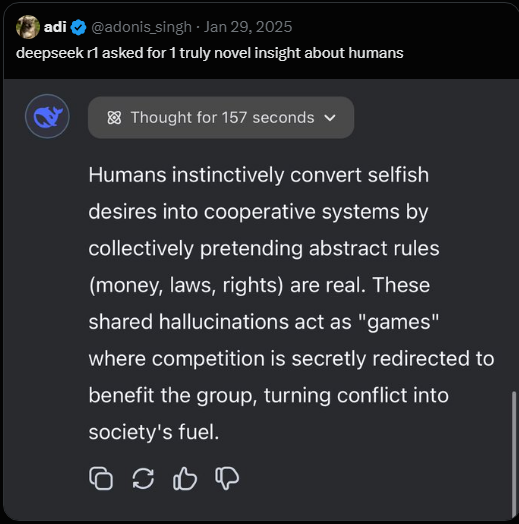
Pretty accurate, really. Exactly why communism fails and capitalism works despite its flaws. A state (those that run it) can not be expected to play a game that only works on the individual cooperative level. Capitalism has mega corps but there is still competition.
The benefits of stable space are enjoyed by all and typically outweigh the mundane tyranny of hierarchies, laws, and the selfish abuses of power.
I like the use of the word "secretly" in R1's response. This is not exactly related to competition, but consider the 2nd Amendment. Despite the problems with an abundance of firearms, there is an invisible and universal benefit -- the violence deterring potential for every victim or bystander to threaten would-be attackers with death. This applies at the individual (criminals), national (police state), and international (foreign armies) level.
That said, ethical mono-cultures that have no guns but leverage shame as a society have less violent crime.
Example: The Fall of Rome ↩︎